



Many teams moving an AI agent prototype to production encounter the same roadblock: durability. A demo agent might work great in a sandbox environment where it only relies on memory. But a production environment introduces more volatility, like sudden restarts mid-execution. Without durability, the agent loses its internal state and the workflow fails.
A typical response is to bolt-on a vector database, state store, and analytics API. But these are separate systems that have to be actively managed to stay in sync. This introduces significant operational complexity and the risk of consistency lag. If your vector store and state store drift out of sync, teams can spend more time debugging distributed systems problems than refining agent logic.
A unified data layer prevents this. Integrating MongoDB with LangChain fuses your agent stack with your data needs, all in one cluster.
The foundation of AI agent memory: the data layer
When AI agents fail in production, the cause is often misattributed to the model or the orchestration layer. But failures can frequently occur when there’s a lag between the vector index and the source data.
These are the three tell-tale stages of this failure mode:
- Stale retrieval: The vector index references records that have been updated or deleted, returning invalid context.
- Silent inconsistency: The agent cannot detect that its context is outdated and proceeds without error.
- Compounding drift: Each turn built on stale context moves the agent further from valid state, making failures harder to detect and more expensive to recover.
We’ll call this failure mode checkpoint-retrieval drift. It occurs when an agent resumes from a valid snapshot but queries a stale or inconsistent index. The agent’s internal variables and memory aren’t consistent with the external data retrieved via RAG.
Avoiding checkpoint-retrieval drift relies on a database that can handle checkpoint recovery, unified vector and metadata retrieval, and atomic state persistence across reasoning traces and data updates.
What’s the best database for production AI agents?
Moving from a working prototype to a resilient production agent with persistent state across turns requires a database that provides three core capabilities:
- Durable Checkpointing: Saving a serialized snapshot of the agent’s state to disk after every tool call, ensuring the system can resume from the last successful step after any interruption.
- Unified Context Retrieval: Querying vector embeddings and operational metadata from the same collection, eliminating synchronization lag between separate databases.
- Atomic State Persistence: Committing reasoning traces and data updates as a single transaction, preventing partial writes from leaving the agent in an inconsistent state.
Checkpointing and unified retrieval are architectural patterns that reduce failure risk and operational complexity. Atomic state persistence, however, is a transactional guarantee that must be supported by ACID to enforce the all-or-nothing execution that agentic workflows depend on.
There’s a fourth capability that production deployments typically surface later, often too late. Once your agents are running reliably, the question shifts from will this work to who can reach it. Which users, services, or pipelines are permitted to query which collections? Are any of those collections holding sensitive data the agent shouldn’t expose in full? That’s a governance and access control problem, and it lives at the MongoDB connection layer, not inside LangGraph. 3T Interceptor Proxy enforces field-level access controls and maintains a full audit trail across all connections to your MongoDB cluster, including the ones your agents use.
How do ACID transactions prevent AI agent state corruption?
As agentic workflows move into production, ACID transactions are the cleanest way to enforce all-or-nothing writes for multi-step state—one valid pattern among several.
An agent managing multi-step reasoning, tool calls, and external data retrieval is executing a sequence of dependent writes. A partial commit corrupts the state the agent depends on to reason correctly. ACID transactions ensure those writes complete together or roll back entirely.
ACID defines four guarantees that make this possible:
| Property | What It Guarantees | Why It Matters for Agent State |
| Atomicity | All writes in a transaction succeed or none do | Prevents partial state commits during crashes |
| Consistency | Data moves from one valid state to another | Ensures the agent never resumes from a corrupted checkpoint |
| Isolation | Concurrent transactions don’t interfere | Protects state integrity in multi-tenant deployments |
| Durability | Committed writes survive system failures | Guarantees checkpoints persist across restarts |
A solid database for agentic AI should consolidate vector embeddings, operational data, and agent checkpoints, with ACID transactions ensuring writes are atomic.
Putting those ACID guarantees into production, the MongoDB Checkpointer for LangSmith persists agent state directly in Atlas, covering crash recovery, time-travel debugging, and durable execution without a separate state store.
How MongoDB supports AI agent state persistence
Production AI agent failures at the data layer result from stale retrieval, silent inconsistency, and compounding drift. These failures occur when vector storage is separate from operational data.
MongoDB Atlas stores vector embeddings and operational data in the same cluster, eliminating the synchronization lag that causes checkpoint-retrieval drift. The MongoDBSaver class in the langgraph-checkpoint-mongodb package connects that cluster directly to LangGraph, persisting agent state between nodes so the system survives process restarts and network interruptions.
How to configure MongoDB for short-term memory storage
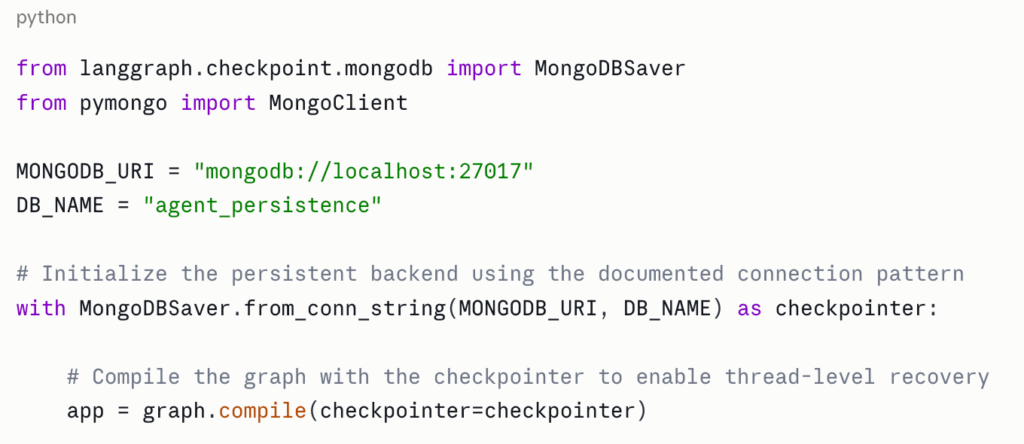
To configure MongoDB as a checkpointer, install and use the langgraph-checkpoint-mongodb package. The MongoDBSaver class directs LangGraph to serialize the agent’s TypedDict state into a BSON document after every node execution, allowing the agent to resume from the last successful step after a crash.
How agent state persistence should work
Agent state persistence is the process of serializing and storing an agent’s complete execution context after every step, so the system can resume from the last successful operation after any interruption. Without it, a process restart or network failure returns the agent to zero.
MongoDB manages that persistence through six steps:
- Context Initialization → Fetch thread_id and initial state from MongoDB.
- Reasoning Turn → LLM processes input and produces a reasoning trace.
- Tool Execution → Agent calls external APIs or local functions.
- State Checkpointing → MongoDBSaver serializes the updated state to BSON and writes it to the database.
- Confirmation → MongoDB confirms the write before execution continues.
- Resume or Exit → Agent proceeds to the next node or returns final output.
Those steps describe a persistence model that works because each layer is doing exactly one job. MongoDBSaver handles serialization, ACID transactions enforce atomicity, and Atlas keeps vector embeddings and operational data in the same cluster. No synchronization jobs, no separate state store, and no compensating logic when something fails mid-write.
For teams moving agentic workflows from prototype to production, that architecture reduces the failure surface at the data layer to a single, well-understood system. MongoDB Atlas and LangGraph handle the rest.
FAQ: Production Agent Infrastructure
Q: Why do agents that work in development fail in production? Development environments run short, single-process sessions with clean inputs. Production introduces process restarts, concurrent sessions, and live data that changes mid-execution. Agents without durable state persistence cannot survive these conditions.
Q: Can I use Atlas Vector Search with LangGraph? Yes. MongoDB Atlas can persist LangGraph agent state and provide Atlas Vector Search for semantic retrieval within the same Atlas cluster. This lets production agents combine durable state and retrieval without introducing a separate vector database. Atlas Vector Search indexes are maintained asynchronously, so newly written or updated data may not be reflected in vector search results immediately.
Q: How does the LangGraph MongoDB checkpointer handle multi-tenant agents? MongoDBSaver uses thread_id to isolate state per user or session, allowing a single collection to manage thousands of concurrent workflows with strict state separation.
Q: What is the recommended retention period for agent memory? Retention requirements vary by use case and regulatory context. Align retention periods with the data governance policies that govern the underlying operational data. Multi-year retention supports long-term auditing and historical performance analysis.
If you’re managing retention at scale, access policies and audit trails become part of the same conversation. 3T Interceptor Proxy lets platform and IT teams define which connections can read or write agent memory collections, and logs every query for compliance review, without modifying the application code or the LangGraph workflow.
Q: How often should I checkpoint agent state? Checkpoint after every node execution or tool call—the default behavior of MongoDBSaver. This ensures the agent never loses more than a single reasoning turn on failure.
Q: What is the difference between agent checkpointers and stores? Checkpointers manage short-term, thread-level state, ensuring a single session can resume after an interruption. Stores handle long-term, cross-thread memory: the langgraph-store-mongodb package allows agents to retrieve preferences, formats, and prior decisions across different conversation threads.
Key takeaways
- State persistence is one of the failure surfaces most underserved by current tooling, and the easiest to address structurally.
- The LangGraph and MongoDB pattern provides a production-ready solution for durable checkpointing via the langgraph-checkpoint-mongodb package.
- Consolidating vector search and operational data into a unified backend eliminates retrieval inconsistency caused by multi-system synchronization lag.
- Multi-document ACID transactions are required to prevent partial state writes during system failures.
- Checkpointers handle thread-level, session-scoped memory. Stores handle long-term, cross-session memory. Production deployments typically require both.
- Building for state persistence from the start is the most direct path from prototype to scale. Agents that fail in production almost always fail at the infrastructure layer.
A note from the 3T team: We publish guest content from the MongoDB ecosystem because our customers are building on MongoDB every day. The infrastructure patterns Tony describes here (durable state, unified retrieval, atomic writes) are the foundation that makes governed data access meaningful. Once agents reach your MongoDB collections in production, the next question is whether the right controls are in place over what they can see and do. That’s the problem 3T Inteceptor Proxy was built for. If you’re at that stage, we’re worth a look.


