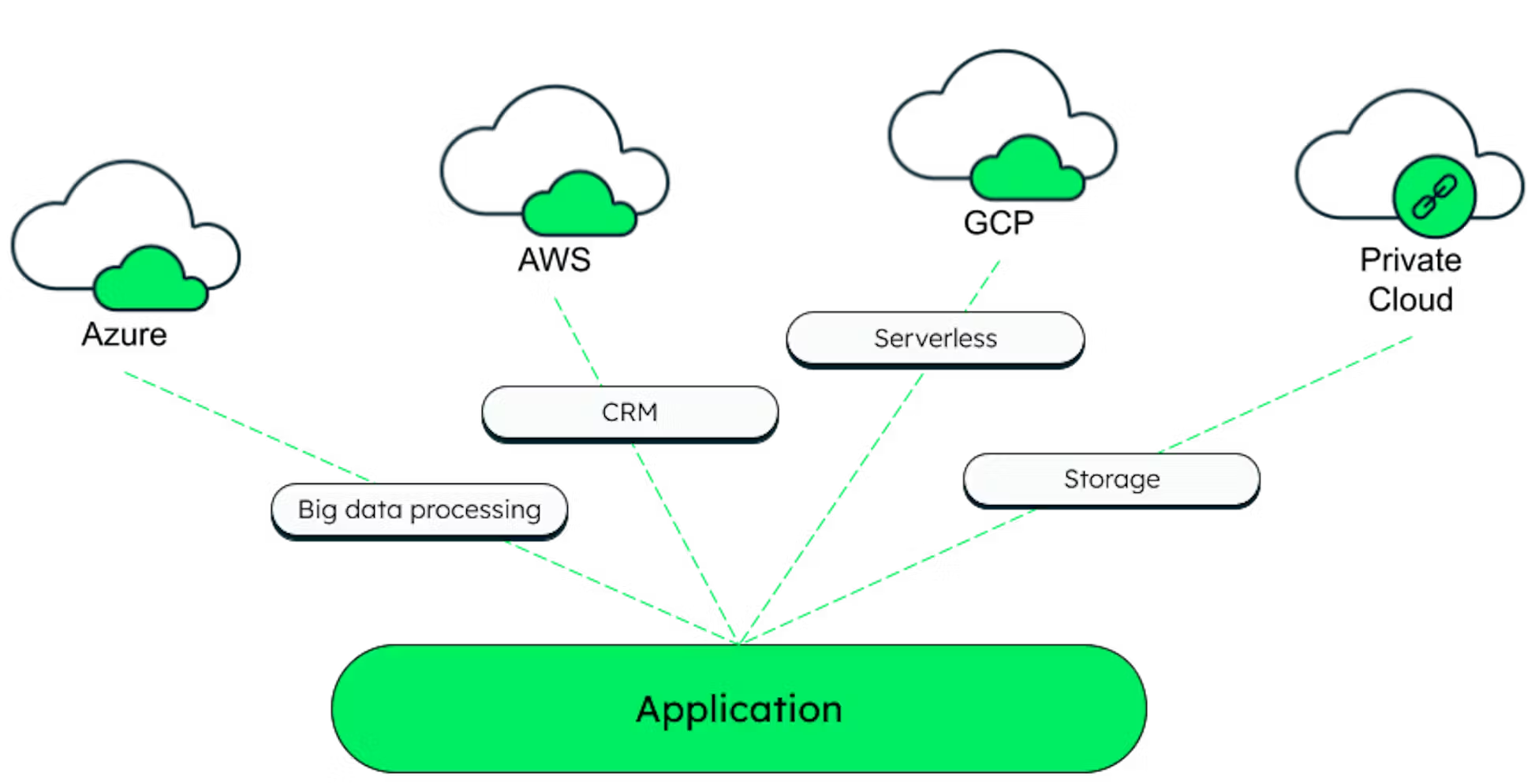
To improve scalability and resilience, organizations are using multi-cloud strategies to run workloads across multiple cloud providers. This primer explains why success depends less on choosing the right cloud provider and more on maintaining consistent data models and access patterns across environments.
What is multi-cloud and how does it work?
Multi-cloud is a deliberate and strategic placement of different workloads on whichever cloud service provides the most optimal fit. For example, an enterprise might run its core infrastructure services on AWS, its content production services on Google Cloud Platform, and its disaster failover on Azure, or all three.
Lots of organizations already use multiple types of cloud services, or run a hybrid combination of on-premises and public cloud services. While both scenarios include multiple clouds, neither qualifies as multi-cloud deployment. Instead, the primary components of a multi-cloud strategy include:
- Build with any cloud service: Select cloud services based on which provider is optimal for which workload.
- Data mobility: Move or replicate data between environments with minimal rework, supported by portable data formats and consistent access patterns.
- Cross-cloud resiliency: Distribute or replicate critical systems across providers to reduce the impact of outages or regional disruptions.
- Meeting customer and business demand: Deploy applications closer to users to improve latency and meet regional availability expectations.
A true multi-cloud strategy is selective, intentional, and focused on maintaining flexibility and control as systems grow, without introducing more complexity. Done well, this can improve performance and latency, increase resilience, and reduce exposure to provider-side failures, not to mention keep up with current customer and data demands.
“The era of a single backup solution is over. Most businesses now implement multi-cloud strategies to enhance resilience and flexibility. On average, organizations today use more than three backup solutions, which also shows the complexity of managing diverse IT environments.”
Unitrends 2025 State of Backup and Recovery Report
Why organizations are adopting multi-cloud as a strategic architecture
Many organizations are adopting multi-cloud strategies to increase resilience, answer the unique demands of AI, and meet strict global regulations. Gartner forecast that worldwide public cloud end-user spending in 2025 reached $723 billion. A Hashicorp State of Cloud Strategy survey found that more than three-quarters (78%) of respondents are spending, or are planning to spend on multi-cloud deployments.
Multi-cloud offers benefits such as:
- Reducing cloud concentration risk: Distributing critical workloads or backup environments across multiple clouds reduces the impact of provider-specific failures.
- Optimizing performance by workload: Each cloud provider offers a different mix of services, SLAs, pricing models, and regional coverage. Match workloads to the platforms where they perform best, instead of forcing everything into a single environment.
- Avoiding vendor lock-in: Preserve flexibility by reducing long-term dependence on any one provider’s infrastructure, pricing, or proprietary services—giving you leverage as requirements and contracts evolve.
- Meeting governance and residency requirements: More easily meet data residency and compliance rules with the ability to run workloads in specific regions without redesigning your entire architecture.
- Improving availability and resilience: Running workloads closer to users can reduce latency, while distributing traffic across providers can limit the impact of outages or large-scale attacks.
Multi-cloud offers powerful optimization choices, it can also bring additional complexity that can overwhelm the benefits if not managed strategically.
“Multi-cloud is muscle, not fat…to avoid dependencies on a single cloud provider, multi-cloud is now seen as strategic in major enterprises.”
Lee Sustar, Principal Analyst at Forrester
Multi-cloud challenges: Managing additional complexity and security
Deploying a multi-cloud strategy does increase operational scope as additional cloud environments are introduced. Without clear boundaries and architectural discipline, that added complexity can outweigh the intended benefits.
Common multi-cloud challenges include:
- Data privacy and protection: Consistent security controls, access policies, and auditability are harder to enforce across multiple cloud environments. Differences in native security models can increase the risk of misconfiguration or gaps in coverage.
- Specialized skills and operational overhead: Each cloud provider has its own tools, services, and operational patterns requiring expertise, training, and coordination, which raises costs and increases reliance on specialized teams.
- Expanding service sprawl: Managing dependencies, versions, and lifecycle policies across vendors can become complex and contribute to sprawl.
- Integration friction between environments: Connecting applications, services, and data across clouds introduces latency, synchronization challenges, and brittle integrations, especially when systems weren’t designed to operate across boundaries.
- Increased overall complexity: More clouds mean more configurations, more tooling, and more failure points. Without consistency, even routine tasks like troubleshooting or scaling can take longer and involve more handoffs.
At the root of many of these challenges is data rigidity, not infrastructure. This is why successful multi-cloud deployments depend on choosing the right data foundation and tooling to reduce friction, preserve consistency, and reduce complexity.
How the data foundation determines multi-cloud success
In multi-cloud architectures, data is the hardest layer to standardize because schemas, consistency guarantees, and access patterns are often tightly coupled to specific cloud-native services.
Document-based models decouple data structures from the underlying infrastructure, allowing applications to evolve without forcing widespread system changes. By maintaining consistent data models and access patterns regardless of the provider, teams can:
- Unify tooling: Use one set of automation and monitoring for all environments.
- Simplify compliance: Enforce data sovereignty and encryption standards globally.
- Predict behavior: Data behaves identically, regardless of which cloud it resides in.
Consistency at the data layer matters as much as flexibility. Using the same data models and access patterns across clouds lets you standardize tooling, automation, and governance. Multi-cloud becomes manageable because data behaves consistently, regardless of where it runs.
Multi-cloud works when data and tooling work together
Platforms built around the document model, such as MongoDB, provide a strong foundation for multi-cloud environments. To simplify managing multi-cloud architectures at scale, a tooling layer like Studio 3T can be leveraged, enabling teams to consistently visualize, manage, and evolve data across clouds, without adding operational complexity.
In summary, multi-cloud success is not determined by how many providers an organization uses, but by how consistently its data behaves across environments. Teams that prioritize portable data models, consistent access patterns, and unified tooling can realize the benefits of multi-cloud without inheriting unnecessary complexity.